
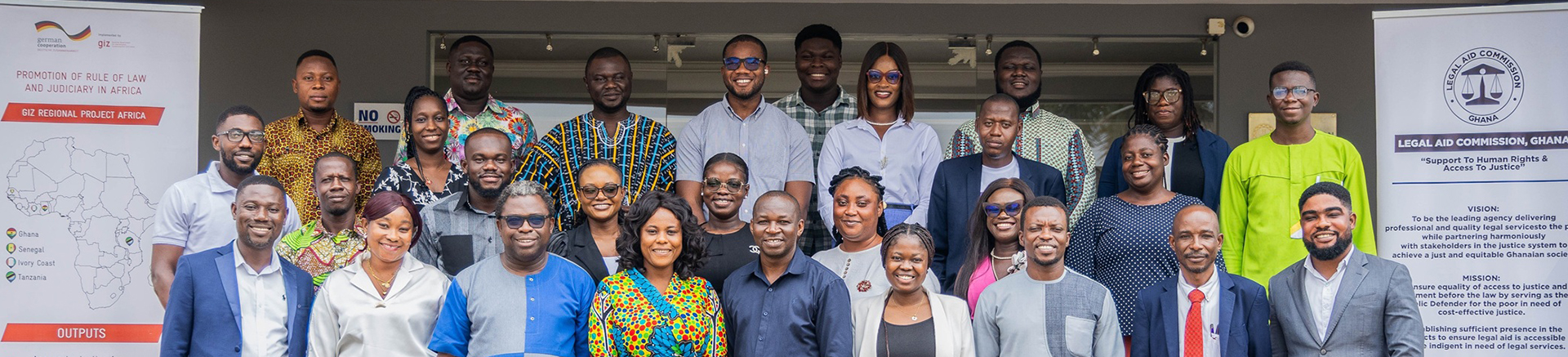
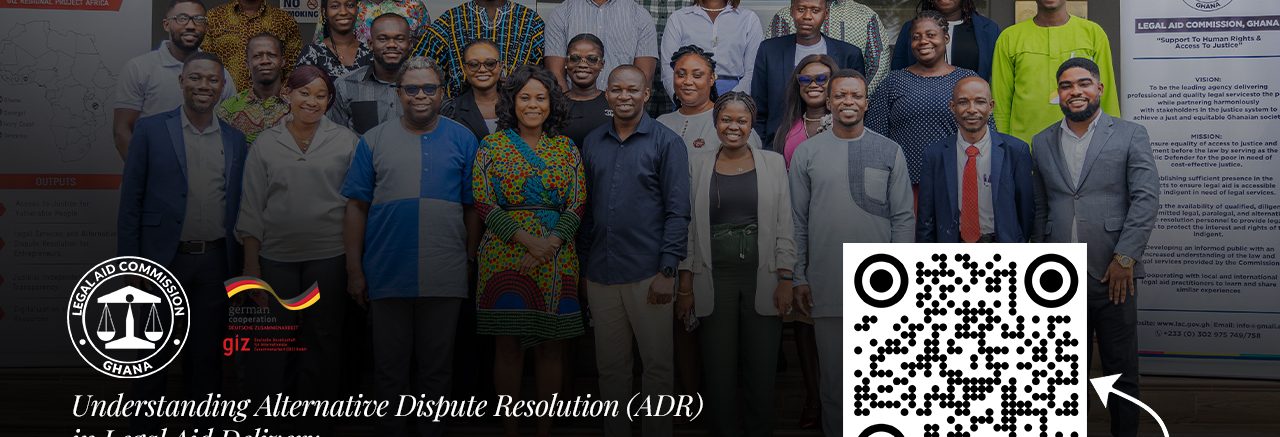
A landmark five-day intensive programme in Alternative Dispute Resolution, held at Hillview Guest Centre, Teiman-Abokobi, Accra, equips LAC officers from across Ghana to serve as professional mediators and community-based justice administrators.
BACKGROUND
The Legal Aid Commission of Ghana is mandated by law to provide free legal assistance and representation to indigent persons across the country. Central to this mandate is the Commission’s growing commitment to Alternative Dispute Resolution — a set of mechanisms that offer communities a faster, less adversarial, and more affordable pathway to justice outside of the formal court system.
In furtherance of this commitment, and with the support of GIZ (Deutsche Gesellschaft für Internationale Zusammenarbeit), the Commission organised a comprehensive five-day Basic Training in ADR, bringing together over 30 staff members and volunteers from LAC offices spanning the length and breadth of Ghana.
THE TRAINING
Held from 25th to 29th May 2026 at the Hillview Guest Centre, Teiman-Abokobi, Accra, the training programme formally titled “Understanding ADR in Legal Aid Delivery” was designed to professionalize the Commission’s frontline ADR and administrative personnel. The training reflects the Commission’s recognition that effective dispute resolution requires a well-coordinated institutional backbone.
The programme was structured around two key themes: Conflict Management and Alternative Dispute Resolution. Participants were taken through a rigorous curriculum that blended theory with practical application, case scenarios, and interactive discussions to ensure skills were not just understood but internalized.
| CURRICULUM HIGHLIGHTS The concept of conflict — nature, sources and types, Conflict management strategies and the retaliatory cycle, The ADR Spectrum: Negotiation, Conciliation, Arbitration and Mediation, Stages of the mediation process — from opening to closure, The role, functions and limitations of the mediator, Interest-Based (Win-Win / Integrative) Bargaining, Ethics and professional standards in ADR practice, Strategies for dealing with impasse in mediation |
KEY INSIGHTS FROM THE PROGRAMME
One of the foundational lessons of the training was the distinction between positions and interests in a dispute. Participants were challenged to look beyond what parties say they want, and to ask why they want it, a skill at the heart of effective mediation and interest-based bargaining.
Using the now-classic example of two sisters disputing an orange, facilitators illustrated how a mediator who simply splits the difference giving each party half, may miss the opportunity for a truly win-win outcome. Had anyone asked, one sister wanted the peel for baking while the other wanted the fruit to eat. The message was clear: ask the right questions.
| “Any breach of common sense is a breach of human rules.” — Jonah Mbazor Esq., Lead Facilitator |
Participants also explored the full ADR spectrum, from negotiation as the first line of resolution, through conciliation and arbitration, to mediation as the Commission’s primary tool. Special emphasis was placed on the principle of self-determination, which holds that parties to a dispute, not the mediator, are the architects of their own resolution.
The training further addressed the retaliatory cycle in conflict, the pattern by which unresolved grievances escalate and equipped participants to identify and leverage conciliatory gestures to break that cycle before it deepens.
FACILITATORS
The programme was expertly facilitated by two ADR Officers of the Commission, whose depth of knowledge and practical approach transformed complex concepts into accessible, actionable skills.
| Jonah Mbazor Esq. Lead Facilitator, Principal ADR Officer, LAC | Philip Offei Asamoah Co-Facilitator, Principal ADR Officer, LAC |
IMPACT ON LAC SERVICE DELIVERY
This training represents a deliberate and strategic investment in the quality of services the Commission delivers to Ghanaians. By equipping staff with professional mediation skills, LAC is strengthening its capacity to resolve disputes at the community level reducing dependence on the courts and making justice more accessible to those who need it most.
Participants are now better positioned to handle a wide range of civil disputes from family and land matters to commercial and workplace conflicts with the confidence, ethics, and technique of trained mediators. The nationwide reach of the training means that this impact will be felt across LAC’s offices from the Northern regions to the South.
The presence of the Executive Director, Edmund A. Foley, at the programme underscored the institutional commitment of leadership to ADR as a cornerstone of the Commission’s service delivery model going forward.
PARTNERSHIP & ACKNOWLEDGEMENT
| SUPPORTED BY GIZ — Deutsche Gesellschaft für Internationale Zusammenarbeit The Legal Aid Commission is grateful to GIZ Ghana for their continued investment in justice sector reform and institutional capacity development in Ghana. This partnership reflects a shared commitment to building the human capital necessary for accessible, efficient, and community-centred justice delivery. |
| RESOLVE DISPUTES THE SMARTER WAY The Legal Aid Commission offers free, Alternative Dispute Resolution (Mediation) services to all Ghanaians. You don’t have to go to court to resolve your dispute. Visit your nearest Legal Aid Commission office today and speak with an officer for assistance. www.lac.gov.gh | Visit any LAC office near you |

 by System Account
  by lacghana